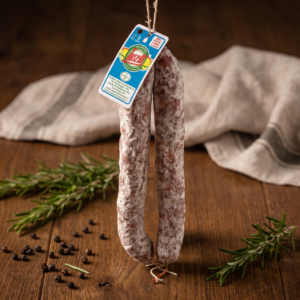
It is quite difficult to establish the precise origin of this charcuterie’s name. It may derive from the expression sala come brisa, referring to the historical use of salt for preservation and the fact that in Valchiavenna, brisa once indicated a heavily salted bovine gland. Others trace the name back to the word brasa (meaning “embers” in the local dialect), as the product was once dried in rooms heated by braziers fueled with fir wood charcoal, juniper berries, thyme, and bay leaves. Over the years, the name evolved from brisaola into bresaola.
What we know with certainty is that this cured meat originates from Valtellina, an alpine valley located in the Lombardy region. Its history dates back several centuries, when local inhabitants began producing it as a way to preserve meat so it could be consumed during the long winter months.
The production of bresaola requires lean cuts of beef, which are specifically trimmed, massaged with a blend of salt, pepper, and spices, and then left to cure for several weeks. During this process, the meat compacts and dries, becoming incredibly tender and flavorful.
Bresaola holds significant historical and cultural importance for Valtellina, so much so that in 1996, it was recognized as a Traditional Italian Agri-Food Product (PAT) by the Ministry of Agricultural, Food, and Forestry Policies.
Today, bresaola is one of the most highly esteemed and widely consumed cured meats in Italy and many other countries worldwide. It is frequently served as an elegant appetizer or used as a premium ingredient in salads and cold dishes, celebrated for its delicate flavor and lightness. Thanks to its outstanding nutritional profile, bresaola is widely considered a healthy choice, perfect for a balanced diet.
| Valori nutrizionali medi per | 100 g |
|---|---|
| Energia | 161 Kcal 680 KJ |
| Proteine | 35 |
| Grassi | 1.9 (0.7 saturated) |
| Sale | 3.3 |